 ZG BAG
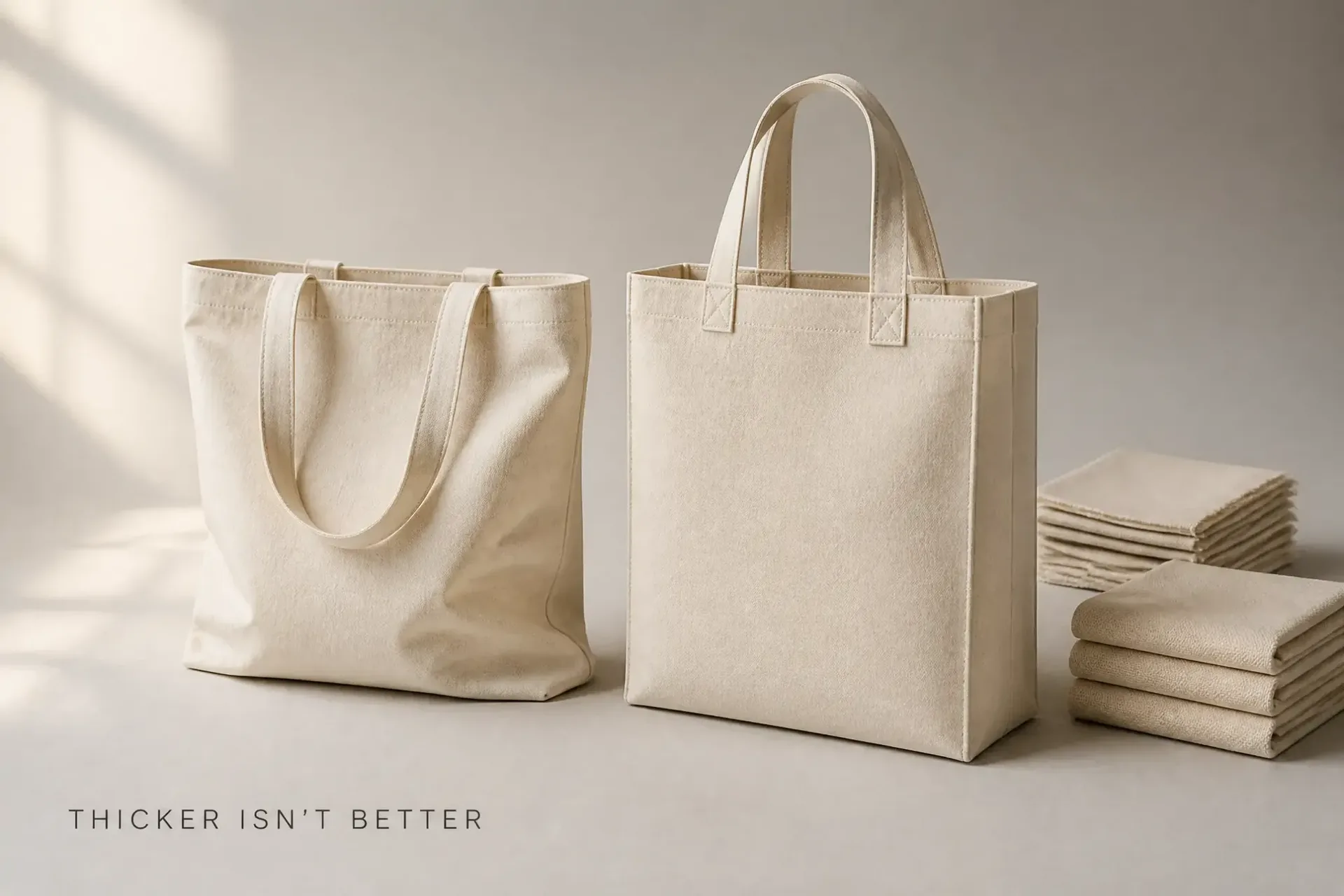
A heavier canvas swatch can feel more substantial, but extra weight does not always add useful value. A bag for lightweight event materials has different requirements from a tote used to carry books every day. Upgrading the fabric without checking the handle attachments may leave the real weakness unresolved.
Clarify the fabric specification
Confirm whether a quote states grams per square meter or ounces per square yard. Fabric weight is not the same as thickness: yarn, weave density and finishing can change stiffness and feel.
Specify fiber composition as well. “Canvas” describes a type of fabric; the name does not prove that a bag is made from pure cotton. If composition matters to your project, include it in the specification and arrange appropriate verification.
Match the upgrade to the intended use
For short events, light contents or compact storage, start by evaluating a lighter construction. For retail or everyday commuting, compare fabrics with more structure alongside the handles and edge finishing. For heavier contents, ask the supplier to meet the target load through the complete construction.
Make the same bag style in two candidate fabrics and load both with the same items. Handling fabric swatches alone will not reveal shoulder comfort or base distortion.
Discuss washability during sampling
Colorfastness and shrinkage are separate issues. A bag can retain its color while changing size. If you intend to describe the product as washable, confirm the care procedure and assess the finished bag, including its handles and decoration.
Dimensional change is especially relevant when the bag must fit a particular box. Avoid promising zero shrinkage or unlimited machine washing without supporting evidence.
Use numbers to compare samples
For example, request samples in 200 g/m² and 300 g/m² fabric, subject to availability and specification confirmation. Keep the bag construction consistent and compare empty weight, loaded shape and carrying comfort. A 50% increase in fabric weight per unit area does not establish a 50% increase in carrying strength.
A proposed wash target could be: after 10 cycles under an agreed 30°C washing procedure and air drying, the absolute dimensional change in both body length and width should not exceed 5%. This is an illustrative design target, not certified or validated performance. Detergent, mechanical action, drying conditions and the definition of a cycle must also be agreed. Set separate requirements for print appearance and color.
If a length changes from 40 cm to 38 cm, it has decreased by 5%. This is a calculation example, not a measured shrinkage result for our bags.
Request a fabric comparison
Tell ZG BAG the expected contents and load, preferred feel, appearance and washing requirements. Contact us to discuss two fabric-and-construction options.
Reference: SGS colorfastness and shrinkage testing (Chinese-language resource). This describes testing topics, not test results for ZG BAG products.